

Bladder showing diverticula die to prostatic enlargement

Object numberGC.64
TitleBladder showing diverticula die to prostatic enlargement
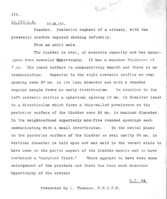
DescriptionBladder, Posterior segment of a urinary, with the prostatic urethra exposed, showing deformity.
From an adult male.
The bladder is cut open showing the exit of the urethra around which there is evidence of prostate enlargement. The prostate enlargement has decreased urinary flow into the urethra which has led to the formation of diverticuli in the bladder to counter the increased volume and pressure of urine in the bladder
The bladder is oval, of moderate capacity and has undergone some muscular hypertrophy. It has a maximum thickness of 7 mm. The inner surface is comparatively smooth and there is no trabeculation. Superior to the right ureteric orifice an oval opening some 38 mm. in its long diameter and with a rounded regular margin forms an early diverticulum. In relation to the left ureteric orifice a spherical opening 10 mm. in diameter leads to a diverticulum which forms a thin-walled prominence on the posterior surface of the bladder some 20 mm. in maximum diameter. In the neighbourhood superiorly are five rounded openings each communicating with a small diverticulum. In the mesial plane on the posterior surface of the bladder an oval cavity 36 mm. in vertical diameter is laid open and was said in the recent state to have been on the pelvic aspect of the bladder muscle and to have contained a "purulent fluid." There appears to have been some enlargement of the prostate and there has been much muscular hypertrophy of the ureters.
Production date Estimate 1808
Production periodNineteenth century, early
Object nameBLADDER
Object categoryAnatomical, specimen
Dimensions
- Container Height: 17.5 cm
Width: 8.5 cm
Depth: 6.5 cm